Thursday, March 10, 2011

A Repost From Anne Cetas of Our Daily Bread


Five-Minute Rule

Text Size: Zoom In
March 10, 2011 — by Anne Cetas
Our Daily Bread Radio is hosted by Les Lamborn
He shall regard the prayer of the destitute, and shall not despise their prayer. —Psalm 102:17

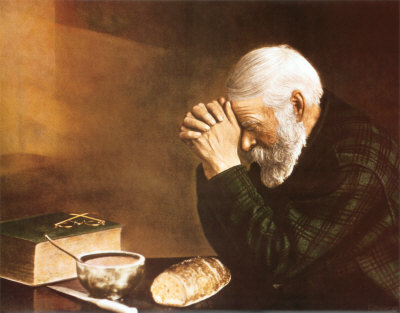
I read about a 5-minute rule that a mother had for her children. They had to be ready for school and gather together 5 minutes before it was time to leave each day.

They would gather around Mom, and she would pray for each one by name, asking for the Lord’s blessing on their day. Then she’d give them a kiss and off they’d run. Even neighborhood kids would be included in the prayer circle if they happened to stop by. One of the children said many years later that she learned from this experience how crucial prayer is to her day.

The writer of Psalm 102 knew the importance of prayer. This psalm is labeled, “A prayer of the afflicted, when he is overwhelmed and pours out his complaint before the Lord.” He cried out, “Hear my prayer, O Lord . . . ; in the day that I call, answer me speedily” (vv.1-2). God looks down “from the height of His sanctuary; from heaven [He views] the earth” (v.19).

God cares for you and wants to hear from you. Whether you follow the 5-minute rule asking for blessings on the day, or need to spend more time crying out to Him in deep distress, talk to the Lord each day. Your example may have a big impact on your family or someone close to you.

The issue isn’t how much time
We spend with God in prayer,
But seeking Him throughout each day
And knowing that He’s there. —Sper

Prayer is an acknowledgment of our need for God.

Reposted From Anne Cetas of Our Daily Bread

Wednesday, March 9, 2011

A Repost From Julie Ackerman Link of Our Daily Bread


Are We There Yet?

Text Size: Zoom In
March 9, 2011 — by Julie Ackerman Link
Our Daily Bread Radio is hosted by Les Lamborn
The Lord your God led you all the way these forty years in the wilderness, to humble you and test you, to know what was in your heart. —Deuteronomy 8:2

If there is any such thing as a universal question, it may be this: Are we there yet? Generations of children have asked it. They have then grown into adults who have to answer the same question when their children ask.

Whenever I read the books of Moses, I wonder how many times he heard that question from the Israelites. Before rescuing them from slavery and leading them out of Egypt, Moses told them that the Lord would lead them to “a land flowing with milk and honey” (Ex. 3:8). He did, but first they spent 40 years wandering in the wilderness. This was no ordinary wandering, however. They were not lost; they were wandering for a purpose. After 400 years of slavery, the children of Israel needed to have their hearts, souls, and minds reoriented toward God. This was accomplished in the wilderness (Deut. 8:2,15-18), but not before an entire generation died because of their disobedience (Num. 32:13).

In life, it sometimes seems as if we are wandering in circles. We feel lost. We want to ask God, “Are we there yet? How much longer?” At such times, it helps to remember that the journey, not just the destination, is important to God. He uses it to humble us, test us, and show us what is in our hearts.

All God’s testings have a purpose—
Someday you will see the light;
All He asks is that you trust Him,
Walk by faith and not by sight. —Zoller

It’s the journey, not just the destination, that’s important.

Reposted From Julie Ackerman Link of Our Daily Bread

Tuesday, March 8, 2011

A Repost From Joe Stowell of Our Daily Bread


Small Things

Text Size: Zoom In
March 8, 2011 — by Joe Stowell
Our Daily Bread Radio is hosted by Les Lamborn
There is a lad here who has five barley loaves and two small fish, but what are they among so many? —John 6:9

Skeptical about the usefulness of a small lunch, Andrew said to Jesus, “What are [these five loaves and two fish] among so many?” (John 6:9). Yet the little lunch in the hands of Jesus turned out to be a huge blessing. So, before you think that you don’t have much to offer Jesus, consider this:

Edward Kimball, a Sunday school teacher in Boston, decided to visit a young man in his class to be sure he was a Christian. That day he led that man, Dwight L. Moody, to the Lord.

Moody, the Billy Graham of the 19th century, had a major impact on Wilbur Chapman. Chapman, a prominent evangelist, recruited Billy Sunday to join in his evangelistic campaigns. In turn, Sunday launched a national ministry that had great results in cities like Charlotte, North Carolina. An organization that started as a result of Sunday’s revival invited evangelist Mordecai Ham to Charlotte. In one of those meetings, Billy Graham received Christ as his Savior and later became the most prominent evangelist of our time.

When you think you don’t have much to offer, remember Sunday school teacher Edward Kimball, who spent a Saturday afternoon reaching out to someone in his class. God has a special way of using routine faithfulness in the “small things” to accomplish great things!

What may seem insignificant,
Mundane, routine, or small
Is often used by God to show
His power over all. —Sper

God uses small things to accomplish great things for His glory.

Reposted From Joe Stowell of Our Daily Bread

Monday, March 7, 2011

A Repost From David H. Roper of Our Daily Bread


Forgetting Ourselves

Text Size: Zoom In
March 7, 2011 — by David H. Roper
Our Daily Bread Radio is hosted by Les Lamborn
Let every man be swift to hear, slow to speak. —James 1:19

I was fishing a local trout stream last summer, when my attention was fixed on a fish that was feeding nearby. I looked up and there on the bank I spied an acquaintance—nationally known fly-fishing guide and outfitter Dave Tucker. Immediately I became aware of my own performance, bungled the next cast, and lost the fish. So it is when we turn our attention away from the activity at hand and think about ourselves.

W. H. Auden has an engaging little poem about those who forget themselves in an activity—a cook mixing a sauce, a surgeon making an incision, a clerk completing a bill of lading. He says that all “wear the same rapt expression, forgetting themselves in a function.” That phrase “forgetting themselves in a function” brings Philippians 2:3-4 to mind: “Let nothing be done through selfish ambition or conceit, but in lowliness of mind let each esteem others better than himself. Let each of you look out . . . for the interests of others.”

When I’m listening to a friend, I need to remind myself to focus on him, not to begin wondering how I look, what he thinks of me, what I should say next. Let’s put others first by listening in rapt attention, concentrating on the one in front of us, forgetting ourselves.

When we hold our tongues and listen,
We communicate our care;
For an open ear speaks volumes
To a heart that’s in despair. —Sper

Listening may be the most loving thing you do today.

Reposted From David H. Roper of Our Daily Bread

Sunday, March 6, 2011

A Repost From Bill Crowder of Our Daily Bread


God’s Flannelgraph

Text Size: Zoom In
March 6, 2011 — by Bill Crowder
Our Daily Bread Radio is hosted by Les Lamborn
Read: Psalm 19
The heavens declare the glory of God; and the firmament shows His handiwork. —Psalm 19:1

In this age of new video technology, it might be hard to believe that some teachers still feel the best way to depict Bible stories is the low-tech flannelgraph board. I recall that my childhood Sunday school teachers used those flat boards covered with flannel, which enabled them to display cutouts of David, Daniel, Jonah, Jesus, and all the other characters. The flannelgraphs helped my teachers capture the essence of the Bible story in an artistic way.

Those old-school flannelgraphs aren’t the oldest graphic teaching devices, however. God has long had a kind of “flannelgraph” of His own, and it is called creation. God uses the marvel of creation to instruct us and to display His power.

In Psalm 19:1, David wrote, “The heavens declare the glory of God; and the firmament shows His handiwork.” In creation, God has revealed Himself so clearly that Paul declared, “His invisible attributes are clearly seen.” Those who have the witness of creation are “without excuse” (Rom. 1:20). Why? On the flannelgraph of God’s creation, we see God’s order and design. We see His power and glory. This should lead us to worship. “O Lord, our Lord, how excellent is Your name in all the earth!” (Ps. 8:1).

With words of great power God formed the world—
By the strength of His voice heaven’s hosts were unfurled;
Now in His honor we worship His name
And in heartfelt devotion His glory proclaim. —Branon

Creation is the canvas on which God has painted His character.

A Repost From Bill Crowder of Our Daily Bread

Saturday, March 5, 2011

A Repost From Dave Branon of Our Daily Bread


Fearful Tears

Text Size: Zoom In
March 5, 2011 — by Dave Branon
Our Daily Bread Radio is hosted by Les Lamborn
So I wept much, because no one was found worthy to open and read the scroll. —Revelation 5:4

John, the great apostle and the one Jesus loved, was reduced to tears.

In a vision he received while imprisoned (Rev. 5:1-12) he found himself in God’s throne room as future events unfolded. In heaven, John saw God hold up a sealed scroll. He wept because as he observed the glories of God’s presence, he saw no one who could open the scroll—no one with the power to reveal God’s final revelation and to complete the concluding chapter of history’s drama.

As an apostle, John had observed the power of sin in the world. He had witnessed Jesus’ life and death on earth to conquer sin. He had seen Him ascend into heaven. But now he was fearful when he saw that no one was worthy to open the scroll and vanquish sin forever (v.4).

Imagine the drama of what happened next. An elder approached John and said, “Do not weep,” and pointed him toward Someone he knew: “Behold, the Lion of the tribe of Judah” (v.5). John looked, and he saw Jesus—the only One with the power to take the scroll, open the seals, and complete the story. Soon John’s tears were dry, and millions of angels were proclaiming, “Worthy is the Lamb!” (v.12).

Are you crying? Behold, John’s friend—Jesus. He is worthy. Turn things over to Him.

Our Lord is worthy all our days
Of all our love and highest praise;
He died to take our sin and shame—
Oh, bless the Savior’s holy name! —Egner

The Lamb who died to save us
is the Shepherd who lives to lead us.

Reposted From Dave Branon of Our Daily Bread

Friday, March 4, 2011

A Repost From Cindy Hess Kasper of Our Daily Bread


Anticipation

Text Size: Zoom In
March 4, 2011 — by Cindy Hess Kasper
Our Daily Bread Radio is hosted by Les Lamborn
I will come again and receive you to Myself. —John 14:3

At the beginning of March, my friend began a countdown. Marked on the calendar in her office were the 20 days left until the first day of spring. One morning when I saw her, she volunteered, “Only 12 more days!” A few days later, “Only 6!” Her enthusiasm started to rub off on me, and I began to keep track as well. “Just 2 more days, Jerrie!” “I know!” she beamed.

As believers, we have something to look forward to that is even more exciting than the anticipation of budding flowers and lots of sunshine after a long winter. God has made many promises in His Word, and each one has been or will be fulfilled. But the certainty that Christ will return is one of the greatest promises of all. “For the Lord Himself will descend from heaven with a shout, with the voice of an archangel, and with the trumpet of God. . . . Then we who are alive and remain shall be caught up together with them in the clouds to meet the Lord in the air,” and we’ll be with Him forever (1 Thess. 4:16-17).

Although no one can know the exact day, we have God’s promise that Jesus will come back (Acts 1:7-11). As we celebrate the spring and coming Easter season, let’s encourage each other in anticipation of that day!

He is coming! Oh, the rapture
To behold His lovely face,
And to tell Him how I love Him,
Who has saved me by His grace. —Dimmock

Christ is coming—perhaps today!

Reposted From Cindy Hess Kasper of Our Daily Bread


Our Guardian Angel Ministers To Our Needs

God's Divine Providence

Followers